Do Not Use Dry Mode in Queensland – Why It Often Makes Things Worse
If you live in Queensland, chances are you’ve seen the “Dry” mode button on your air conditioner remote and wondered if it’s a cheaper, smarter way to deal with humidity.
We get asked about this all the time on the Sunshine Coast, and the answer often surprises people:
👉 Dry mode is usually not suitable for Queensland conditions and can actually make your home feel more uncomfortable, not less.
In this article, we’ll explain what dry mode actually does, why it’s rarely effective in Queensland’s climate, and what you should use instead to stay comfortable while protecting your system.
What Is Dry Mode on an Air Conditioner?
Dry mode (sometimes shown as a water droplet icon 💧) is designed to reduce humidity rather than cool the room.
When dry mode is activated:
- The air conditioner runs the fan and compressor intermittently
- Cooling is minimal
- The system focuses on removing some moisture from the air
In theory, it’s meant for mild, slightly humid conditions — not tropical or subtropical climates.
Why Dry Mode Doesn’t Work Well in Queensland
Queensland’s climate is hot, humid, and often coastal. This is where dry mode falls short.
1. Queensland Humidity Is Too High
Dry mode simply cannot keep up with sustained high humidity levels.
Instead of steadily removing moisture:
- The unit cycles on and off
- Moisture removal is inconsistent
- Humidity quickly builds back up
The result? That sticky, clammy feeling that never really goes away.
2. It Often Makes Your Home Feel Warmer
Because dry mode limits cooling:
- Room temperatures can rise
- Your body struggles to cool itself
- The air feels heavy and uncomfortable
Many people end up turning the temperature down further or switching modes repeatedly — which defeats the purpose entirely.
3. Fan Coil Freezing, Defrosting & Excess Moisture Issues
In Queensland’s high humidity, dry mode can cause unstable system operation.
Because the unit runs intermittently:
- The fan coil can become excessively cold
- Moisture builds up rapidly on the coil
- The system then defrosts repeatedly
This freeze–defrost cycle creates large amounts of excess condensation.
In ducted systems, that moisture doesn’t just disappear — it can:
- Drain poorly or overflow
- End up in the ceiling space (roof cavity)
- Increase humidity above the ceiling
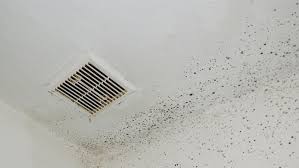
Over time, this creates ideal conditions for roof cavity mould, damp insulation, and musty smells that can spread back into the home.
4. Increased Risk of Mould and Odours Inside the System
Intermittent operation is a major issue in humid regions.
When your system:
- Doesn’t run long enough
- Repeatedly freezes and defrosts
- Leaves moisture sitting on coils and internal components
…it creates an environment where mould and bacteria can thrive.
This is especially common in:
- Coastal Queensland homes
- Ceiling-mounted ducted fan coils
- Systems frequently used on dry mode
5. Not Recommended for Ducted Systems
For ducted air conditioning, dry mode can cause additional problems:
- Poor airflow balance across zones
- Uneven comfort throughout the house
- Reduced overall efficiency
Modern ducted systems are designed to manage humidity while cooling, not separately.
What Should You Use Instead?
✅ Cooling Mode (Yes, Really)
In Queensland, cooling mode is almost always the better option.
Why?
- It removes moisture as a by-product of cooling
- The system runs longer and more consistently
- Indoor humidity stays more stable
Set your system to:
- 24–25°C in summer
- Fan speed on auto
This gives your air conditioner enough runtime to properly dehumidify the air.
✅ Make Sure Your System Is Correctly Sized
An oversized system:
- Cools too quickly
- Shuts off before removing enough moisture
A correctly sized system:
- Runs longer
- Removes more humidity
- Feels far more comfortable
If your home always feels damp even when cooled, sizing may be the real issue.
✅ Regular Servicing Is Essential in Humid Areas
Queensland systems work hard.
Regular servicing helps:
- Prevent mould growth
- Keep drain lines clear
- Maintain proper dehumidification
- Extend the life of your unit
This is especially important for coastal homes on the Sunshine Coast.
When Can Dry Mode Be Used?
Dry mode isn’t completely useless — it’s just rarely right for Queensland.
It may be suitable when:
- Temperatures are mild (around 20–22°C)
- Humidity is only slightly elevated
- You’re using a split system for a short period
Even then, cooling mode usually delivers better comfort.
The Bottom Line
While dry mode sounds appealing, it’s generally not designed for Queensland’s climate.
For most homes, most of the time:
- ❌ Dry mode = poor comfort and higher mould risk
- ✅ Cooling mode = better humidity control and consistent comfort
If you’re unsure how to set your system or feel your home never quite feels right, it may be time to get professional advice.
Need Help With Your Air Conditioning?
At The Cool Shop, we help Sunshine Coast homeowners:
- Optimise air conditioner settings
- Improve comfort and efficiency
- Reduce humidity and mould risks
📞 Contact us today for friendly, honest advice or a free quote.
Written for Queensland conditions by The Cool Shop – Sunshine Coast air conditioning specialists.