Learn how your ducted air conditioning system actually breathes.
When most people think about ducted air conditioning, they notice the ceiling outlets blowing warm or cool air into each room. But there’s another part of your system working just as hard that often goes unnoticed—the return air vent.
Without a properly designed return air system, even the best air conditioner can struggle to keep your home comfortable.
In this guide, we’ll explain:
- What a return air vent does
- Why its location is so important
- How the supply and return air plenums work together
- Common design mistakes
- Why bigger isn’t always better
What Is a Return Air Vent?
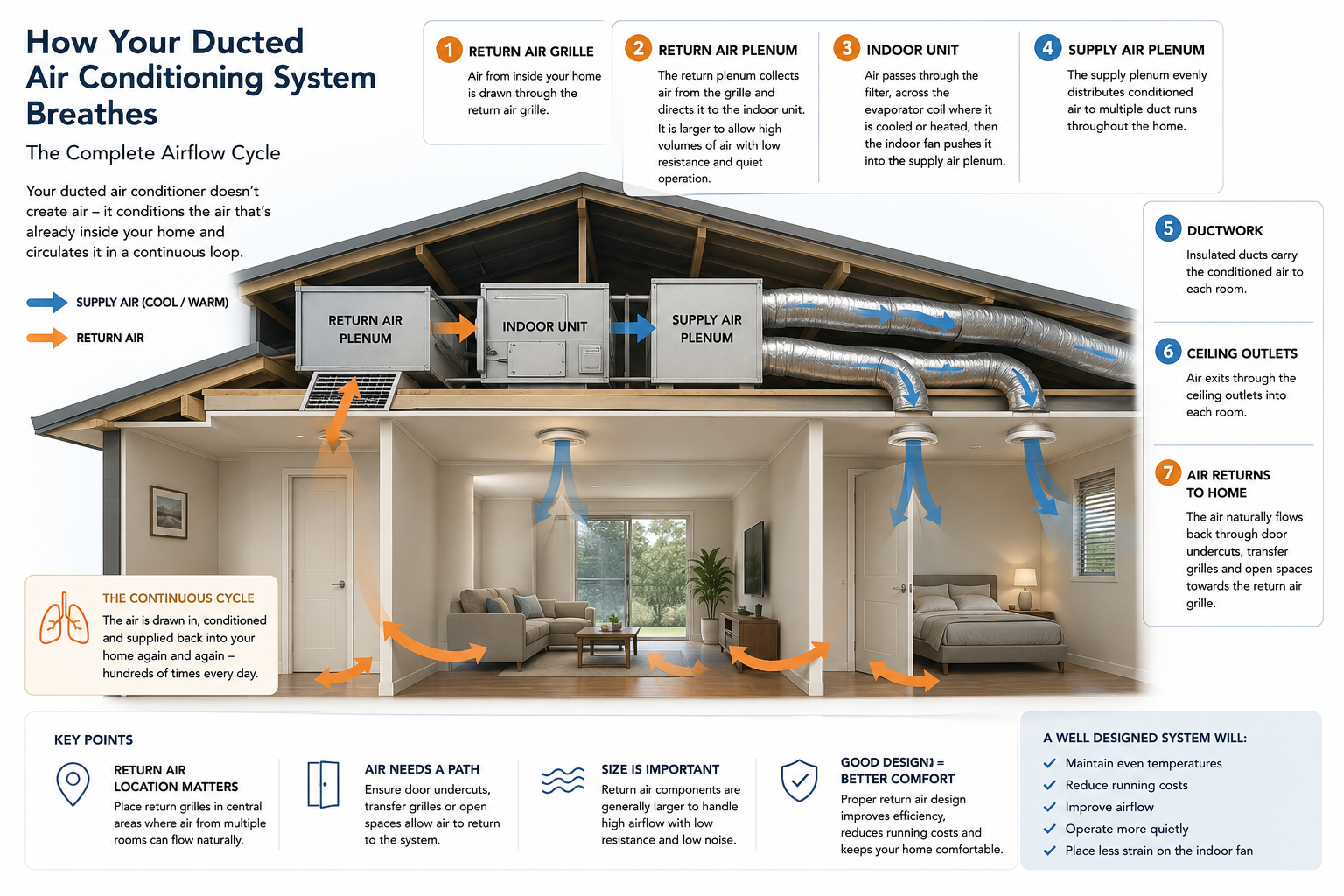
Your ducted air conditioner doesn’t create air—it simply conditions the air that’s already inside your home.
The return air vent acts like the system’s breathing intake. It draws air from inside your home back into the indoor unit where it is:
- filtered
- heated or cooled
- circulated back through the ductwork.
Think of it like your own lungs.
- The return air is the inhale.
- The supply outlets are the exhale.
Without both working together, your system can’t operate efficiently.
How Air Travels Through Your Home
Imagine a continuous loop.
- Air is pulled through the return air grille.
- It passes through the filter.
- The indoor fan pushes it across the evaporator coil.
- The conditioned air enters the supply air plenum.
- It travels through insulated ducts.
- Air exits the ceiling outlets into each room.
- The air naturally finds its way back to the return grille.
Then the process repeats hundreds of times every day.
What Is the Supply Air Plenum?
The supply air plenum is a large insulated box connected directly to the indoor unit.
Its job is to evenly distribute conditioned air into multiple duct runs.
Rather than the fan pushing air into one large pipe, the plenum acts like a traffic controller, directing airflow to every room throughout the house.
A well-designed supply plenum helps:
- balance airflow
- reduce air noise
- minimise pressure losses
- improve efficiency
What Is the Return Air Plenum?
The return air plenum performs the opposite job.
Instead of distributing air, it gently collects air from the home before feeding it back into the indoor unit.
This is why return plenums are generally much larger than supply ducts.
They need to move a high volume of air with as little resistance as possible.
Too small…
- noisy airflow
- reduced efficiency
- fan strain
- higher running costs
Too large generally isn’t a problem, but poor placement certainly is.
Why Return Air Vent Location Is So Important
This is where professional design makes all the difference.
Your return air vent should ideally be located in a central area of the home where air from multiple rooms can naturally flow back to the system.
Good locations include:
✔ Hallways
✔ Open living areas
✔ Central family rooms
Poor locations include:
❌ Inside bedrooms (unless specifically designed)
❌ Near kitchens where cooking grease can be drawn into the system
❌ Bathrooms where moisture may enter the ductwork
❌ Laundry areas with excess humidity
Why Bedroom Doors Matter
Here’s something many homeowners don’t realise.
If every bedroom door is closed, the supply outlets continue blowing air into the room.
But where does that air go?
Without an escape path, pressure builds inside the room.
Meanwhile, the return air vent can’t draw that conditioned air back through the system.
This can reduce airflow, increase noise and make the air conditioner work harder.
That’s why many homes include:
- door undercuts
- transfer grilles
- jump ducts
- relief vents
These allow air to flow back towards the return air grille even when doors are closed.
Can You Have More Than One Return Air Vent?
Absolutely.
Larger homes often have multiple return air grilles connected to a common return air plenum.
This helps:
- improve airflow balance
- reduce noise
- lower return air velocity
- maintain even temperatures
The number and size of return air vents depends on the home’s layout and the air conditioner’s airflow requirements.
Common Return Air Mistakes
Some of the most common issues we see include:
- Return grille too small
- Poorly positioned grille
- Furniture blocking airflow
- Dirty return air filters
- Bedrooms with no return air path
- Flex duct that’s too long or kinked
- Undersized return plenum
Any of these can reduce efficiency and comfort.
Why Professional Design Matters
A ducted air conditioning system is much more than simply connecting ducts to an indoor unit.
Correct airflow calculations, duct sizing, plenum design and return air placement all work together to deliver quiet, efficient and comfortable operation.
A professionally designed system will generally:
- maintain more even temperatures
- reduce running costs
- improve airflow
- operate more quietly
- place less strain on the indoor fan
Need Advice on Ducted Air Conditioning?
Whether you’re building a new home, renovating or replacing an older system, ensuring the return air system is correctly designed is just as important as choosing the right air conditioner.
At The Cool Shop, we design ducted air conditioning systems to suit your home’s layout—not just the size of the unit.
If you’re located on the Sunshine Coast, contact our team for expert advice and an obligation-free on-site quotation.