Supply Air vs Return Air – What’s the Difference?
If you have ducted air conditioning in your home, you’ve probably heard the terms supply air and return air. But what do they actually mean, and why does your air conditioning system need both?
The difference is quite simple:
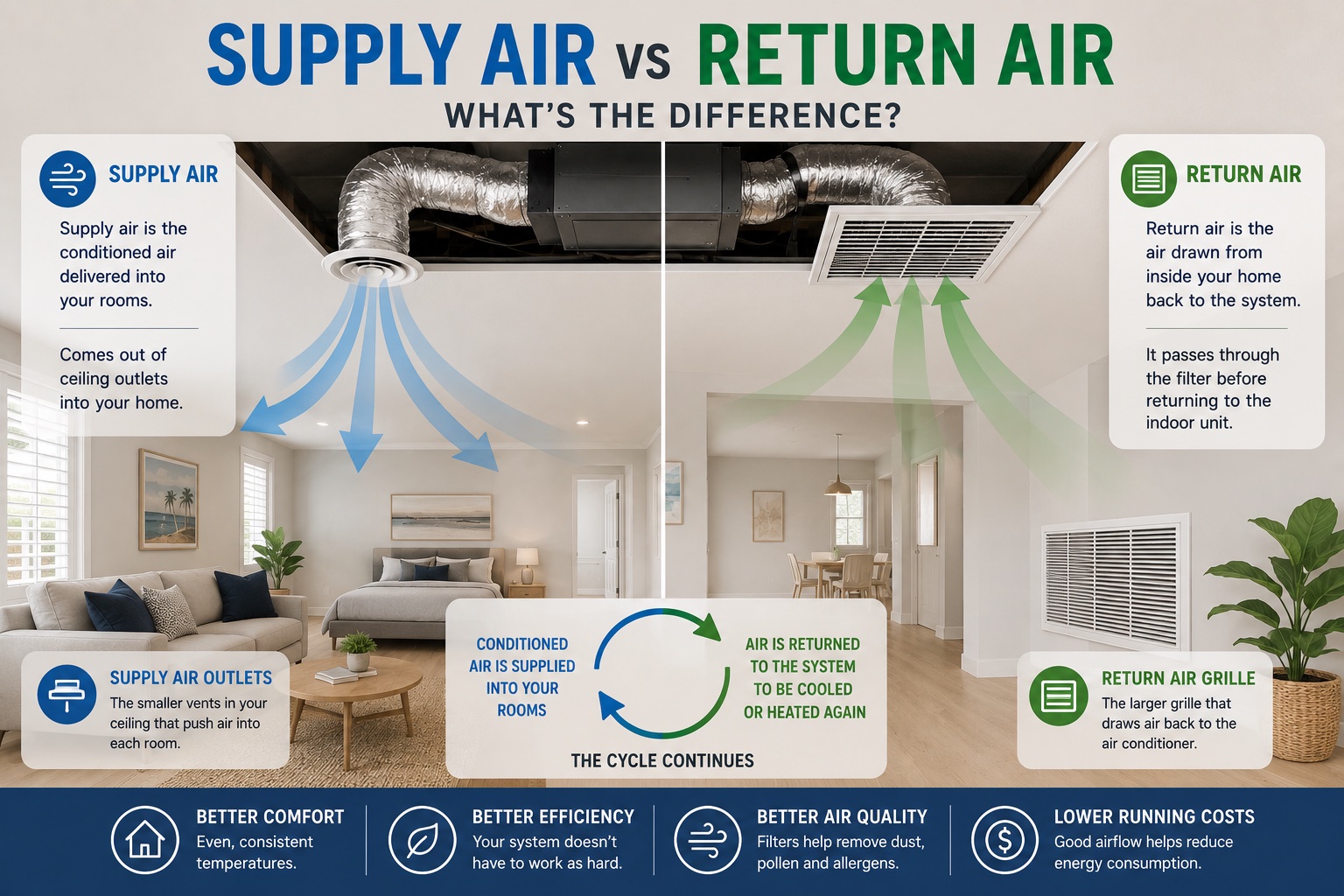
Supply air is the conditioned air being delivered into your rooms. Return air is the air being drawn back into the air conditioning system.
Both are essential parts of a ducted air conditioning system. Without good supply airflow and an adequate return air path, your system can’t circulate air around your home effectively.
What Is Supply Air?
Supply air is the cooled or heated air that your ducted air conditioner delivers into the rooms of your home.
After air passes through the indoor unit, it travels through the ductwork and is distributed into different rooms through supply air outlets, sometimes simply called air conditioning vents.
These are usually the smaller ceiling outlets you’ll see throughout bedrooms, living areas and other conditioned spaces.
Depending on the installation, supply air outlets may be round or square and can come in several different styles.
Their job is to distribute conditioned air throughout the room as effectively and evenly as possible.
What Is Return Air?
Return air works in the opposite direction.
Instead of delivering air into a room, the return air grille draws air from inside your home back to the indoor air conditioning unit.
The air passes through the return air filter before travelling back to the indoor unit, where it is cooled or heated again before being redistributed through the supply air ducts.
This cycle continues while your ducted air conditioner is operating.
In most residential ducted systems, you’ll have multiple supply air outlets throughout the home but only one or sometimes a small number of larger return air grilles.
Why Is the Return Air Grille So Much Bigger?
This is something homeowners often notice.
Your supply air is divided between multiple outlets around the house. Your return air, however, may need to collect enough air to supply the entire system through a single return air grille.
That’s why the return air grille is usually considerably larger than an individual supply air outlet.
The return air grille and ductwork need to be correctly sized so the system can draw back the volume of air it requires without excessive restriction.
How Supply and Return Air Work Together
A ducted air conditioning system isn’t constantly bringing large amounts of new air into your house.
For a typical residential recirculating ducted system, it is primarily circulating and conditioning the air already inside your home.
The process looks something like this:
Room air → Return air grille → Filter → Indoor unit → Supply ductwork → Supply air outlets → Rooms → Return air grille
And then the cycle starts again.
This is why both sides of the airflow system matter.
Having plenty of supply air isn’t much use if the system can’t draw enough air back through the return.
What Happens If Supply Airflow Is Restricted?
Supply airflow can become restricted for several reasons, including closed outlets, damaged or crushed ductwork, incorrect duct sizing or problems with the system itself.
You might notice:
- A room isn’t cooling or heating properly
- Very little air coming from an outlet
- Uneven temperatures between rooms
- Unusual airflow noise
- The system taking longer to reach the desired temperature
If one room has noticeably less airflow than the others, it doesn’t necessarily mean the air conditioner itself is faulty. The problem may be with the airflow or ductwork supplying that particular area.
What Happens If Return Airflow Is Restricted?
Return air restriction can affect the performance of the whole ducted system, rather than just one room.
One of the most common causes is also one of the easiest to fix: a dirty return air filter.
Other causes can include furniture or stored items obstructing a return air grille, an incorrectly sized return air system or problems within the ductwork.
Signs of restricted return airflow can include:
- Reduced airflow from multiple supply outlets
- Longer running times
- Poor heating or cooling performance
- Increased airflow noise
- Higher energy consumption
- The system struggling to reach the set temperature
This is one reason we recommend homeowners check and clean their return air filter every month.
It’s a simple job most homeowners can do themselves and can make a significant difference to airflow.
Is a Return Air Vent the Same as a Supply Air Vent?
No.
Although people often refer to both as “vents”, they perform completely different jobs.
A supply air outlet pushes conditioned air into the room.
A return air grille draws air back towards the air conditioner.
An easy way to tell the difference is by size and location.
You’ll generally see several smaller supply outlets throughout the home, while the return air grille is usually much larger and positioned in a central location such as a hallway.
Why Does Return Air Location Matter?
Where the return air grille is positioned can have a significant effect on how effectively air circulates through the home.
It needs to have an unrestricted pathway to collect air from the conditioned areas.
This is also why things such as closed bedroom doors, poor door clearances and badly positioned return air grilles can sometimes contribute to airflow problems.
A ducted air conditioning system should be designed as a complete airflow system, rather than simply deciding where to put the supply outlets.
Should You Close Supply Air Vents in Unused Rooms?
This depends on how your ducted system has been designed and zoned.
If your system has proper zoning, use the zone controls as intended rather than manually closing ceiling outlets.
Closing too many supply outlets can alter the airflow and static pressure the system was designed to operate with.
If you’re unsure which outlets or zones should remain open, it’s better to have the system checked rather than experimenting with closing multiple vents.
Good Ducted Air Conditioning Starts with Good Airflow
When people think about ducted air conditioning, they naturally focus on the air coming out of the ceiling.
But that’s only half of the story.
For your system to operate effectively, it needs to be able to deliver conditioned air and bring air back again.
Correctly designed supply air and return air systems can help provide:
- More even temperatures throughout your home
- Better airflow
- Improved comfort
- More efficient operation
- Less unnecessary strain on the system
That’s why duct design, outlet placement and return air sizing are such important parts of a quality ducted air conditioning installation.
Need Advice About Your Ducted Air Conditioning?
If some rooms in your home aren’t cooling properly, your airflow seems weak or you’re considering installing a new ducted air conditioning system, The Cool Shop can help.
We design, install, service and repair ducted air conditioning systems across the Sunshine Coast, with careful consideration given to airflow, ductwork, return air and the individual layout of your home.
Contact The Cool Shop today to arrange an on-site quote or speak with our team about your ducted air conditioning system.